

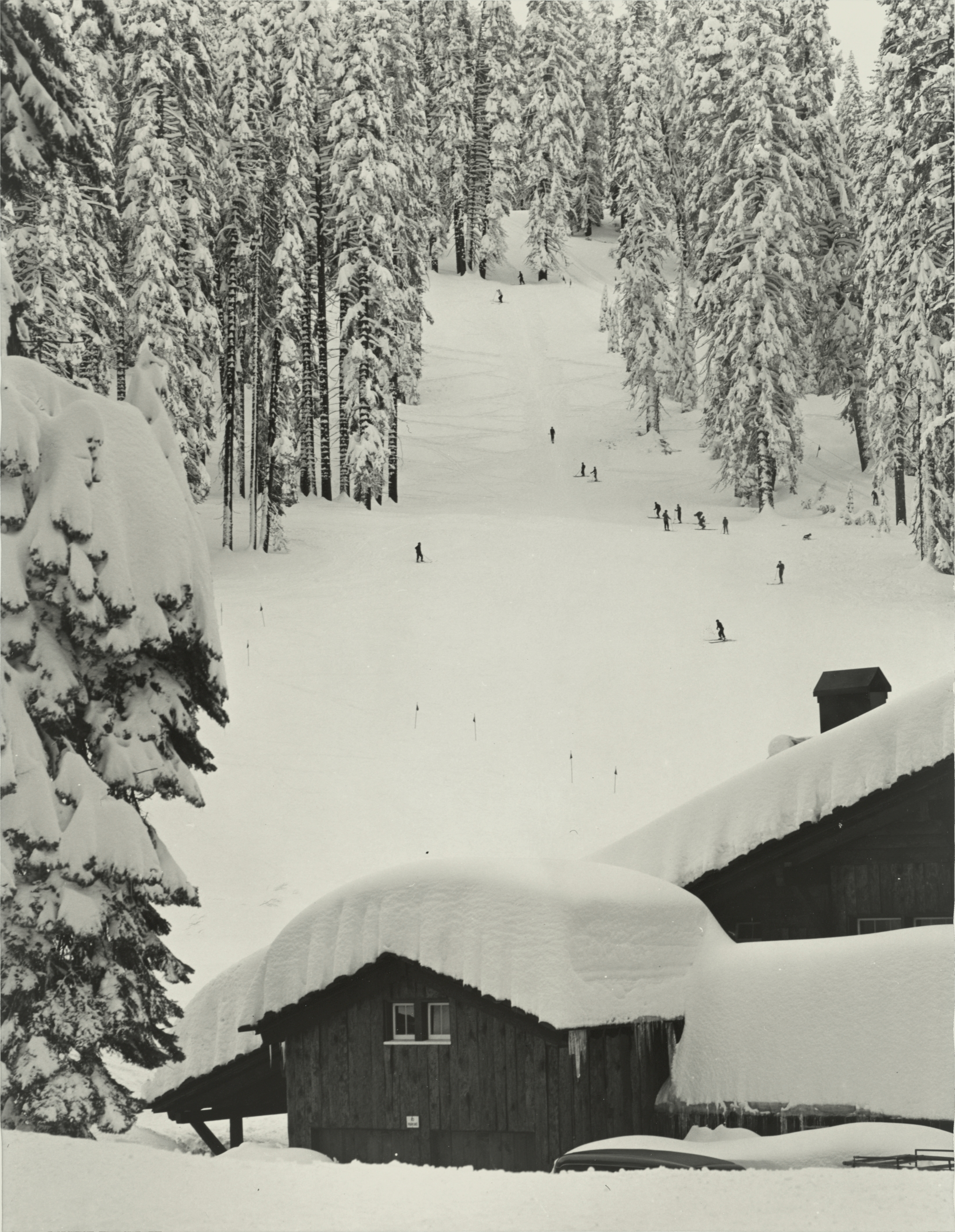
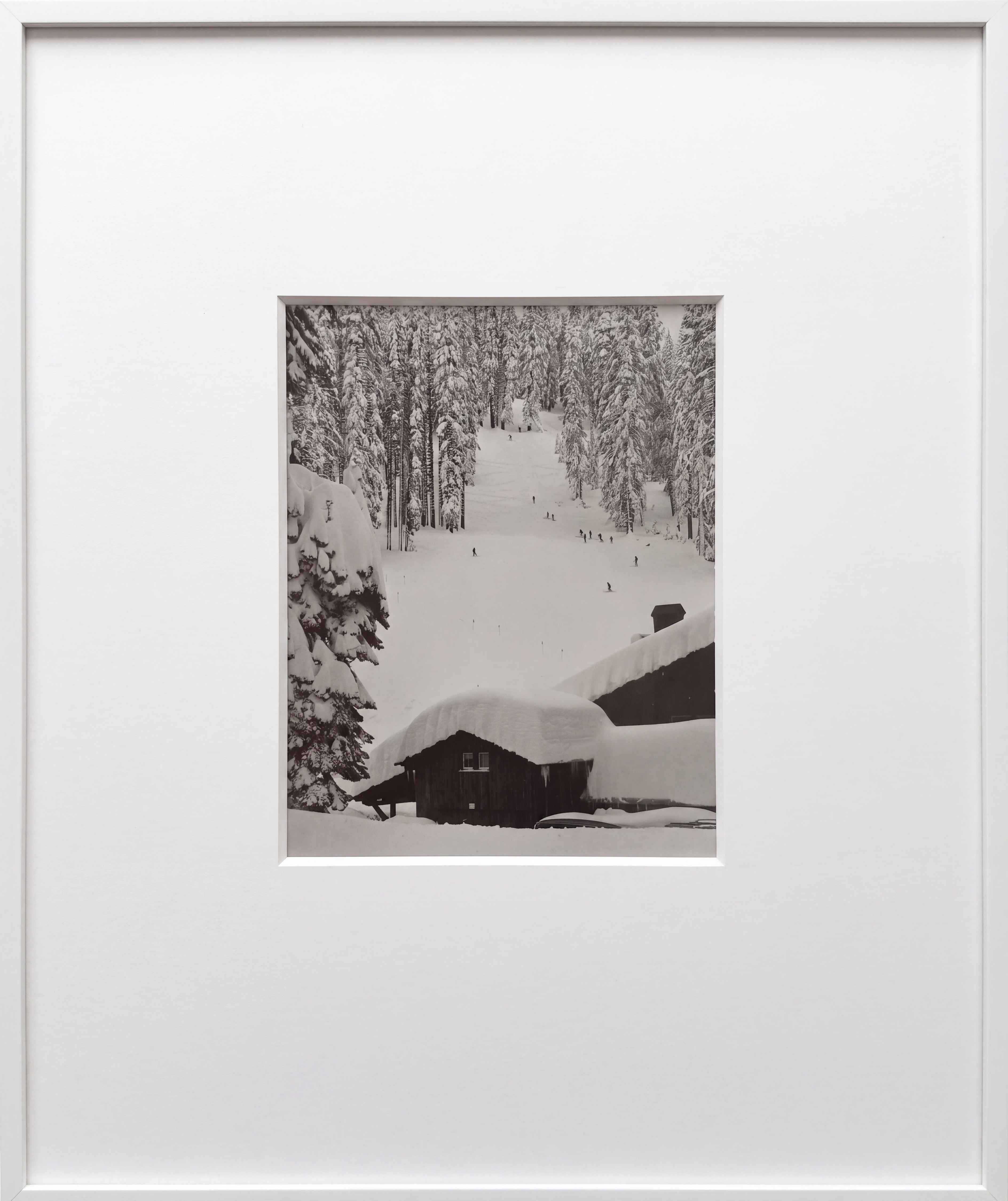
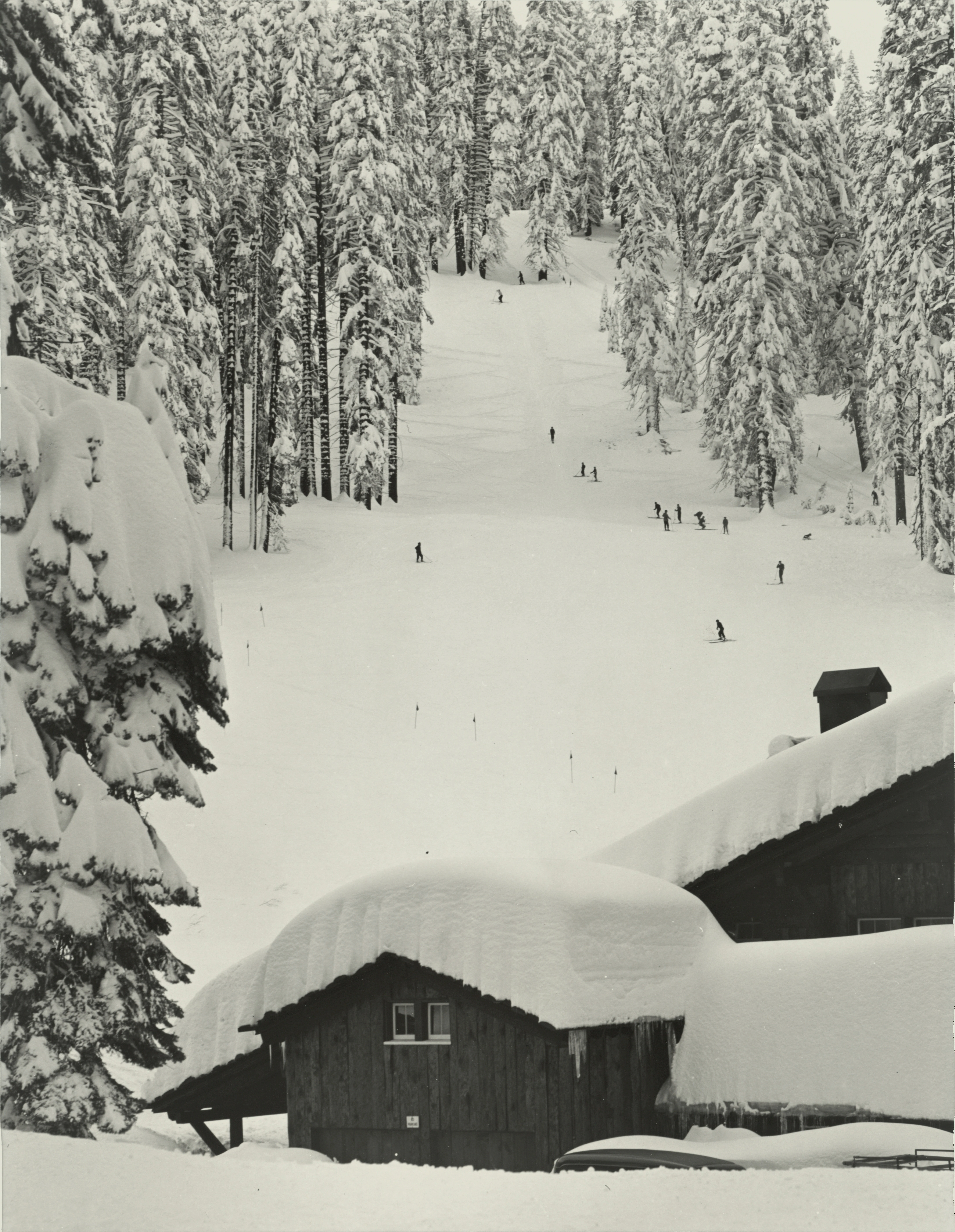
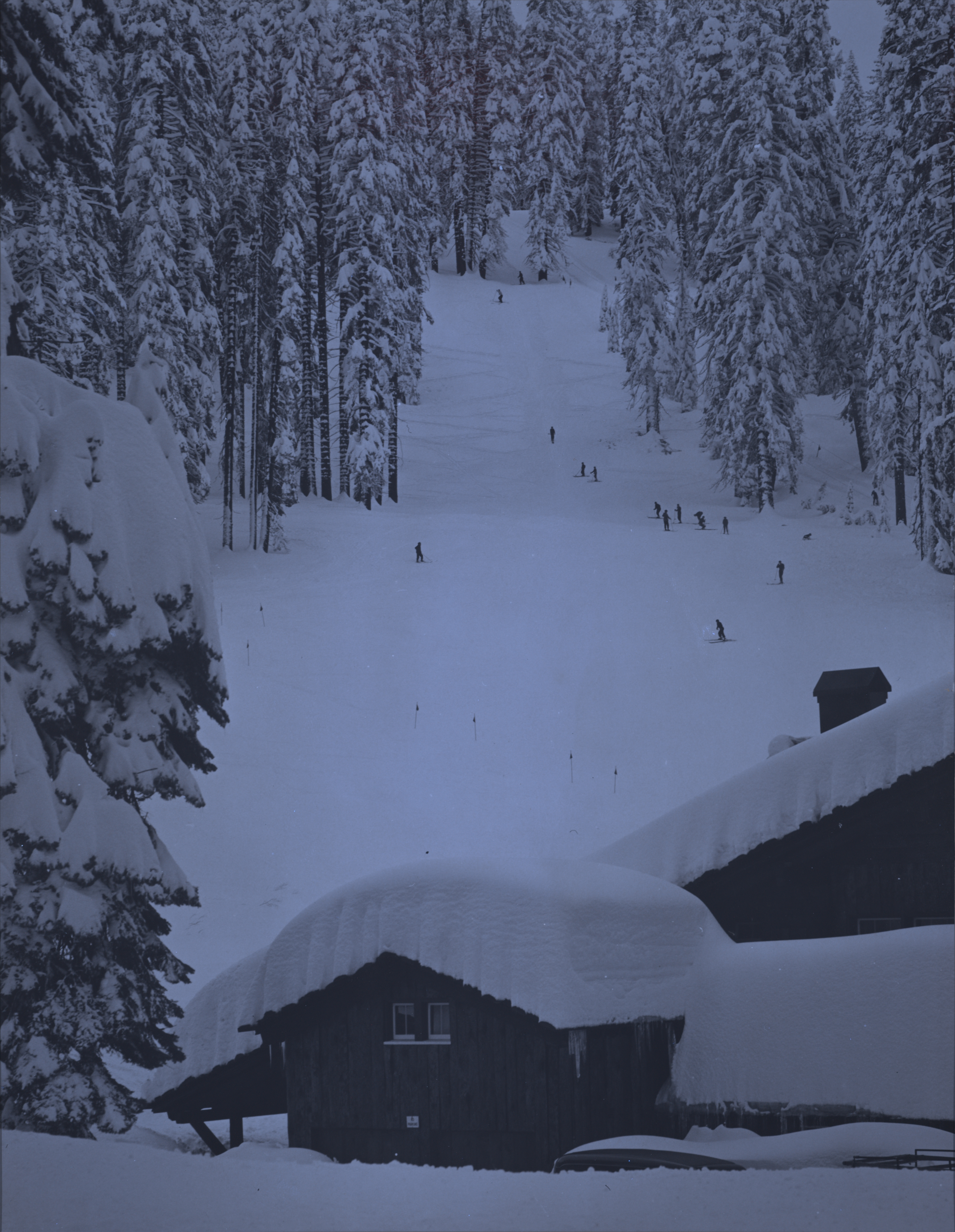
The Ski House at Badger Pass, c. 1935
- Image
- c. 1935
- c. 1937
- Size
- 8⅝ × 6¾in
- Medium
- Gelatin silver print
- Mount
- Unmounted
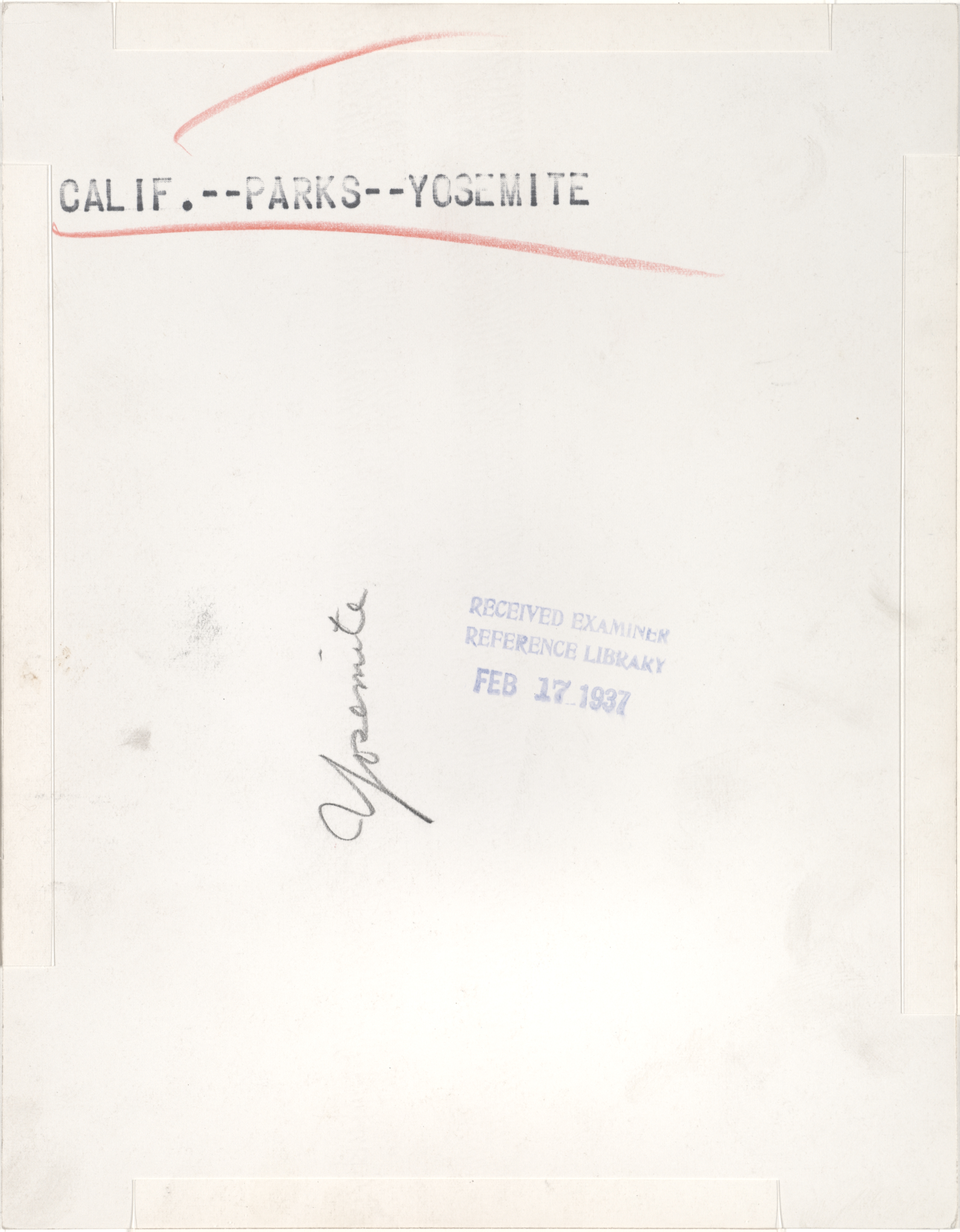
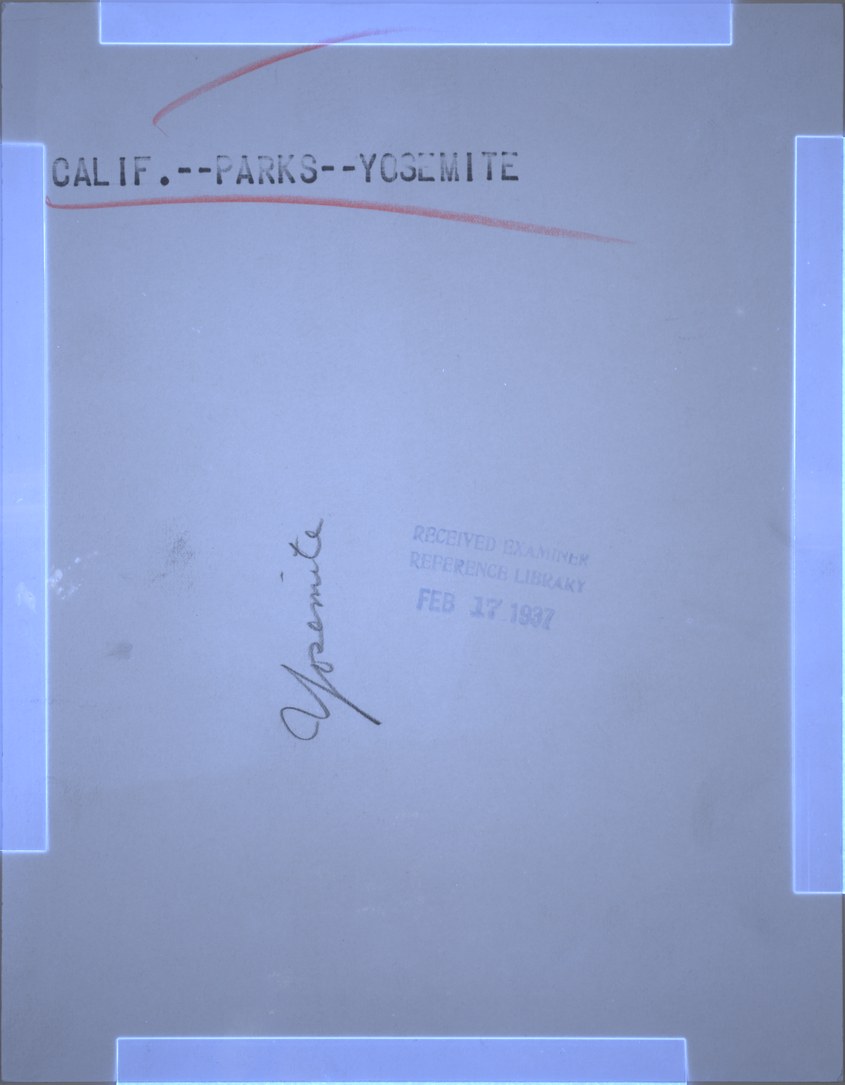
Calif.—Parks—Yosemite stamp, red-crayon underline; Yosemite in pencil; blue San Francisco Examiner reference-library stamp, Feb 17 1937.
-
Kodak Azo, 193693%
-
Kodak Azo, 197591%
-
Kodak Velox, 195291%
Dots mark agreement across the sheet's three scans · Yale / Messier reference library.
This unmounted gelatin silver print, 8⅝ × 6¾ in, is in overall excellent condition. Every defect noted below is visible only in raking light — none is apparent in normal viewing.
A uniform warm tone, consistent for its age, with a very slight greenish cast — a characteristic of Kodak Azo.
- Matte areas in the lower-left, upper-left, upper-right and center-right.
- Soft linear impression along the top edge, and a crescent handling crease in the lower-right quadrant.
- Hard crease at the top edge near the upper-right corner that breaks the emulsion.
- Soft impressions in the center that do not break the emulsion.
- Embedded fibers in the upper-left quadrant, likely original to the paper.
- Pin-sized impressions throughout, on close inspection.
- Edge bumps throughout, consistent with an unmounted sheet.
- Faint silvering in the shadows, on close inspection.
A ski resort built inside a national park — and the photograph made to sell it.
In the winter of 1935 the Yosemite Park & Curry Company opened a ski lodge at Badger Pass and put Ansel Adams to work photographing it. This view — published as The Ski House at Badger Pass — is early, working Adams: made for the park, not the gallery wall, at the moment California's first alpine ski resort was invented.
“The Ski House at Badger Pass.”
Yosemite Park & Curry Company, ed. Stanley Plumb · 1936
The slope only became a resort once roads, a tunnel, and a lift had tamed the climb — about 3,200 feet above the valley floor.
This view is one picture in a campaign. Adams had already photographed skiing as Sierra Club high-country touring — Lembert Dome, Tuolumne — so he knew the sport from inside. From about 1929 Donald Tresidder put that knowledge to work for the Curry Company, hiring Adams to sell Yosemite's empty winter season. The commission grew into a whole sales system — photographs, a film, window displays, Ahwahnee menus, postcards and advertising prints, much of it staged from a shooting script — and the Ski House sits at the center of it.
In The Four Seasons in Yosemite National Park (1936) Adams's winter pictures run as a sequence, and this one is its hinge.
In that arc the Ski House is the practical anchor — the picture that says the place is real, you can reach it, and skiing starts here. Its claim is specific: not a lodge portrait, but the hinge image of Yosemite's winter turning from scattered high-country sport into an organized ski destination. It may also be scarce — Andrea Stillman notes that most of Adams's Curry Company winter work was lost to a 1937 darkroom fire, and survives mainly in a few early prints.